Thursday, 30 April 2015

Poolsbrook country park site case study. Sustainability.


Poolsbrook is in Derbyshire and is a caravan site.

It was developed on a brownfield site (an area with previous construction)

Uses sustainable energy features to reduce costs such as:

  • Solar heating panels
  • Photovoltaic panel to convert sunlight into electricity
  • Wind turbine
  • Low energy light bulbs
  • A ground source heat recovery system that exploits geothermal energy

They also realise that by promoting sustainability it is a useful marketing and advertising tool.

Won awards in 2009 for both regeneration and sustainability.

Wednesday, 29 April 2015

Curitiba Case Study - Sustainable City


Curitiba is in Brazil and is recognized as one of the most sustainable cities in the world. It is in east Brazil and has a population of 1.8 million.


Started in 1970 when a team led by Jaime Lerner devised a plan to incorporate ecology, efficient transport, user friendly open spaces along with other goals.


Key aspects of Curitiba include:
  • Very efficient bus system where lanes are designated for buses to make journeys quicker and there is a 5 pronged star shape road network to increase efficiency. The bus is cheap (single priced ticket system) and makes travelling quick and easy. 75% of commuters take the buses and this results in 25% less congestion and 30% reduction in fuel consumption.
  • Encourage recycling and have a green swap system, this encourages people to walk to a local recycling point where they can swap their waste for bus tickets, food etc. 2/3 of the city's waste is now recycled. The program is voluntary but 70% of households participate.
  • There is a lot of open space (28 parks) and pedestrianization which increases the stand of living and also the environment. 52 square metres of green space per person. Builders are encouraged to crate green areas with their buildings by being given tax breaks.
  • Encourages non-polluting and hi-tech industries has been successful in achieving growth, avg growth rate of 7.1% (national average of 4.2%). There is high wealth in Curitiba with 66% higher per capita incomes than the Brazil average.

Tuesday, 28 April 2015

Nepal Earthquake - A level Geography


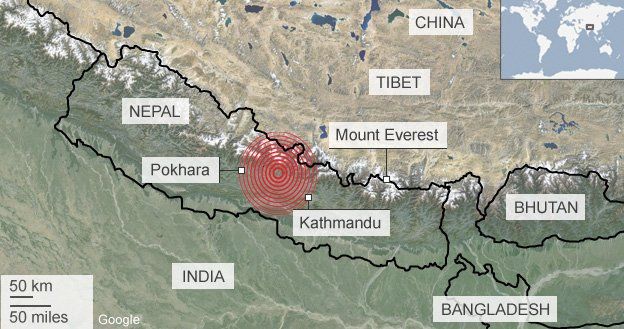
Nepal earthquake map


On Saturday 25th April a 7.8 earthquake measuring on the richter scale hit just 80km outside of Kathmandu (capital of Nepal).
The region had 2.5 million people living there.
Today the death toll stands at 5000+ and expected to rise.
The earthquake occurred where the Indian plate is being sub ducted beneath Eurasian plate at a destructive plate boundary. The India plate is moving at 5cm a year towards Asia. A powerful 6.7 tremor hit on Sunday as an aftershock.
The 19th century, 200 step Dharahara tower in Kathmandu collapsed.


Problems with the response is that much of the worst hit areas are mountainous therefore the roads to deliver aid via are blocked by debris making the response slow in areas. There as been a slow response with aid with many locals complaining about the government not helping them move out or helping them with food. Nepal's one airport has struggled to cope with the huge amount of aid that is being flown in therefore it is stockpiled there and not being distributed efficiently.


Subsidies - Economics Unit 1

A subsidy is a type of benefit given by the government in order to remove some sort of burden and increase the consumption of merit goods. An example is subsidies for wind farm investment in order to encourage them.


Here is a diagram of a subsidy. 
The area of deadweight loss is the cost to society created by market inefficiency. This is because total surplus with a subsidy is under that of when it is in a free market.

The size of the subsidy is the difference between P1 and P2. The cost of the subsidy is whole shaded area. You work it out by finding new equilibrium point taking it across,  then taking it up to original supply curve then taking it across 

Subsidies are usually seen as government intervention when there is an under consumption of a merit good. Therefore a way of solving an externality. I will go into detail on another post.

Saturday, 25 April 2015

Tax - Economics Unit 1 + 3

TAX  A tax is a compulsory charge made by the government, on goods, services, incomes or capital.
Reasons for tax:

  • Raise government revenue
  • reduce inequality
  • reduce competitiveness of foreign goods
  • influence public spending

Tax - Unit 1:

  • Direct tax is tax levied on an individual or organisation ie. income or corporation tax.
  • Indirect tax is usually levied on purchase of goods or services. A tax on expenditure.
Indirect tax 

Has two types. Tax raises the price of a good by adding to the supply curve and shifting it left. In unit 1 taxes are used to solve negative externalities. ie. use of cigarettes.

  • Ad Valorem tax - charged as a percentage of the price of the good. ie. VAT is 20%. Causes pivotal rotation of supply curve.


  • Specific tax - charged a fixed amount per unit of a good. ie. excise tax on wine. Causes a parallel shift of the supply curve. 


The incidence of tax falls on partly the consumer and producer but the majority is dependent a combo of the PED and PES for that good. Goods that have inelastic demand such as addictive products ie. cigarettes, usually the incidence falls mainly on the consumer. This means the firm can pass on a higher price to them as they are willing to pay. 
A diagram shows how the incidence falls.
Here is a relatively even incidence but in some cases it can be heavily on the consumer or heavily on the producers dependent on the elasticities.


Tax - Unit 4:
Two types of tax already mentioned. Indirect is levied on expenditure and direct are those that cannot be passed on to anyone else and levied on income and wealth.
main direct taxes are income, corporation and capital gains. 
Three broad categories for taxes:
  • progressive tax - as you get richer you pay more tax ie. income. to redistribute wealth.
  • proportional - the percent you pay stays constant. ie. earn 10% more so you're taxed 10% more.
  • regressive - the poorer you are the more you pay. ie. VAT, you can argue that as a percent of income they pay more than the rich. 
The Laffer curve
The laffer curve shows that in theory tax gets to a certain level where people pay then when it goes any higher people are disincentivised (due to more income going to government) and tax revenue decreases.
After tax rate of M the revenue starts to decrease, this is showing that people are not incentivised.


The Growth Of China

China Today...
Second largest economy in the world GDP= $9.24 trillion
worlds fastest growing major economy (however in 2014 suffered slowest growth for 24 years, still 7.2%)
Second largest trading nation and largest exporter of goods
Since 1978 the average income has x4
during last 10 years has contribute more than 30% to global economy
Attracts most FDI in the world

How did it get there?
China's rapid growth started when it switched from a centrally planned economy to a more market orientated economy in 1978 under Deng Xioping. This opened up China to all sorts of opportunities. TNCs started to use the country an an export platform which made it a major competitor on that field to the Asian Tigers.
FDI was initially encouraged in SEZs (small enterprise zones) which were situated along the coast. In early 1980s the number of SEZs was expanded to a total of 17 (14 coastal, 3 inland). These SEZs were areas that had separate, more relaxed regulations and improved infrastructure in order to attract FDI. Shanghai is an example of an SEZ.
China joined the WTO in 2001 which allowed it greater access onto the global market.
China had competitive advantages due to their large population, cheap labour force and their ability to push policies through quickly.


However this growth caused many problems...
There have been massive disparities in incomes creating huge inequality. Areas are being left behind such as Suchuan and many rural areas.
Rapid industialization has caused major pollution in the form of smog and polluted waters (31/52 of the major lakes have severe pollution). Acid rain falls on 30% China.

Seismic Waves

There are two main types of seismic waves

  1. body waves
  2. surface waves
Body Waves
Body waves travel through the boy of the earth.
  • P-waves: Longitudinal waves (movement of particles is the same direction as the wave). They travel through air, liquid and solids (through solids at 5000 m/s. They hit first and are the fastest of the two body waves.
  • S-waves: the next wave that hits is the S-wave. This is a transverse wave (movement of particles perpendicular to direction of wave). Slightly slower than the P-waves and only travel through solids.
Surface Waves
Travel through the surface and are more destructive than body waves
  • Love waves: transverse waves that are very damaging to structures' foundations
  • Rayleigh waves: Longitudinal waves that are slightly slower than love waves.